FAQ · Common Objections
What About…?
Ten of the strongest objections to the theory, with the book's answer to each. The full treatment is in Steelmanning the Opposition (Chapter 18) and the chapters that follow it.
Each entry below is a question worth taking seriously. Click any related concept link to read more about the underlying idea.
Isn't this just wishful thinking?
No. The theory accepts every premise mainstream materialism accepts, then follows those premises more rigorously than usual. Its argument is that the standard "death is final" view is actually the one that does not follow from materialism's premises. Superimmortality emerges from refusing to add anything supernatural, not from wanting the conclusion.
What about Derek Parfit's view that personal identity isn't what matters?
Parfit argued that psychological continuity, not strict identity, is what matters in survival. The book agrees strict identity is the wrong frame, but goes further. What matters is ixperiencitness: the quality that makes any future consciousness your consciousness. That quality is not tied to causal continuity at all.
Doesn't the Hard Problem of Consciousness make this impossible to verify?
The hard problem says we cannot yet explain why physical processes produce subjective experience. The book's argument does not depend on solving the hard problem. It only requires that the same physical structure reliably produces the same subjective experience, which is what the production premise asserts and what neuroscience broadly accepts. The correlation is well-established even if the mechanism is not.
If a perfect copy of me is made, isn't that copy a different person?
From the outside, yes. There are now two physical bodies with different histories. From the inside, both bodies produce ixperiencitness: the experience of being you. Both have your memories, your values, your felt sense of selfhood. The book's claim is that the question "which one is the real you?" has no fact of the matter. Both are.
How could you ever falsify this theory?
Chapter 19 of the book takes the question seriously. The theory would be falsified if (a) consciousness turns out to depend on something other than physical structure, such as a soul or a non-reproducible quantum state; (b) two bodies with identical structure and functioning could produce different conscious experiences; or (c) the universe turns out to be finite in a way that makes structural recurrence impossible. None of these is currently supported by evidence.
Doesn't this require the universe to be infinite?
Strictly speaking it requires only recurrence: that patterns of brain structure can occur again somewhere, sometime. An infinite universe makes this trivially true. A very large but finite universe still allows very high probability of recurrence. Even a small universe with technological civilization (capable of deliberately producing replicas) suffices. Infinity is not required.
What about Boltzmann brains? Doesn't this reduce to that absurdity?
Boltzmann brains are spontaneous fluctuations that produce momentary consciousnesses with no environment, no past, and no future. The theory does not deny they are possible. It argues that the overwhelming measure of recurrent you-ness comes from contextual sources: continuing replicas, deliberate reproductions, and evolved or engineered minds. Boltzmann brains are statistically negligible next to coherent re-occurrences.
Is this religion in scientific clothes?
No. Every premise the theory uses is something neuroscience and physics already accept. There are no souls, no afterlife realms, no divine actors. There is only structure, functioning, and the recognition that physical patterns can recur. The conclusion sounds religious because religious traditions also noticed that consciousness might persist. They invoked supernatural mechanisms. The book reaches a similar intuition through stricter materialism, not weaker.
Doesn't the teleporter problem prove identity requires continuity?
Many people's intuition says the teleported copy is not really you, just a duplicate that thinks it is. The book argues this intuition comes from an unexamined assumption: that consciousness is tied to a particular hunk of matter rather than to its structure. Once you grant the production premise, the teleported copy is you in every way that matters, because it produces your ixperiencitness. Continuity is psychologically reassuring, but not metaphysically required.
If I am supermortal, does death still matter?
Yes. The book is clear that the death of an individual awarepath is real and final. That particular sequence of conscious moments ends. What recurs is your ixperiencitness, not that specific lifetime. Grief, loss, and the value of any one life all remain. What changes is only the assumption that a particular death ends you. It ends a path through you. It does not end the conditions that produce you.
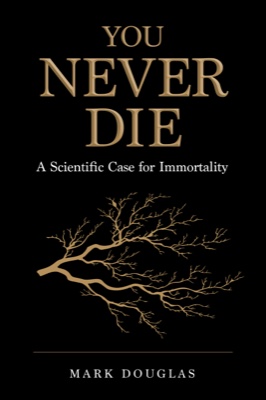
The book takes objections head-on
Part Four of You Never Die (chapters 18, 19, and 20) is dedicated entirely to the strongest objections, to falsifiability, and to the mathematics the theory rests on.